
The Physics of Pipe Rupture: Why Frozen Pipes Burst
A common misconception among homeowners is that a frozen pipe bursts at the exact spot where the ice plug forms. In physical reality, pipe ruptures typically occur downstream or upstream between the closed faucet valve and the expanding ice dam.
As liquid water approaches 32 degrees Fahrenheit (0 degrees Celsius), its molecular structure rearranges into a crystalline hexagonal matrix, causing volume to expand by roughly 9%. When water freezes inside a rigid copper or galvanized pipe, the ice plug adheres firmly to the internal pipe wall. As freezing progresses along the line, it acts as an immovable hydraulic piston, displacing remaining liquid water toward the closed fixture.
Because liquid water is practically incompressible, hydraulic pressure within the trapped zone escalates dramatically -- frequently exceeding 2,000 to 3,000 PSI. Standard residential copper and PEX piping is engineered to operate at 40 to 80 PSI. Eventually, the metal or polymer wall yields at its thinnest point, splitting longitudinally. The split remains plugged by ice until ambient temperatures rise, at which point hundreds of gallons of pressurized water pour into wall cavities and living spaces.
Identifying Vulnerable Plumbing Locations in New York Homes
Certain architectural configurations are particularly susceptible to freezing during sustained Central, Upstate, and Western New York winters:
- Uninsulated Rim Joist Cavities: The perimeter band joist where the home's wood framing meets the concrete foundation often leaks cold outdoor air directly across water lines.
- Exterior Wall Plumbing Chases: Kitchen sink supply lines routed through uninsulated exterior walls or cantilevered second-story overhangs (such as bay windows or room bump-outs).
- Unheated Crawl Spaces and Cellars: Vented crawl spaces that allow sub-freezing crosswinds to circulate directly beneath bathroom subflooring.
- Outdoor Hose Bibbs: Non-frost-free sillcocks or exterior spigots left connected to garden hoses over winter, trapping water inside the valve body where it freezes through the foundation wall.
Safe Homeowner Actions: Why Open Flames Must Never Be Used
If you turn on a faucet during a winter cold snap and receive only a trickle or complete silence, immediate action is required:
- Open the Affected Faucet: Turn the hot and cold handles on slightly. As the ice begins to melt, flowing water helps carry away cold and provides an escape route for expanding steam and pressure.
- Expose Pipes to Ambient Room Heat: Open vanity and kitchen sink cabinet doors to allow warm room air to circulate around plumbing. Run a portable space heater in the room, keeping it safely clear of combustible materials.
- NEVER Use a Blowtorch or Open Flame: Applying a propane torch to frozen pipes is a primary cause of residential structure fires. Open flames ignite paper-faced fiberglass insulation and dry framing lumber inside wall chases. Furthermore, intense localized heat turns trapped ice into high-pressure steam, triggering explosive pipe blowouts.
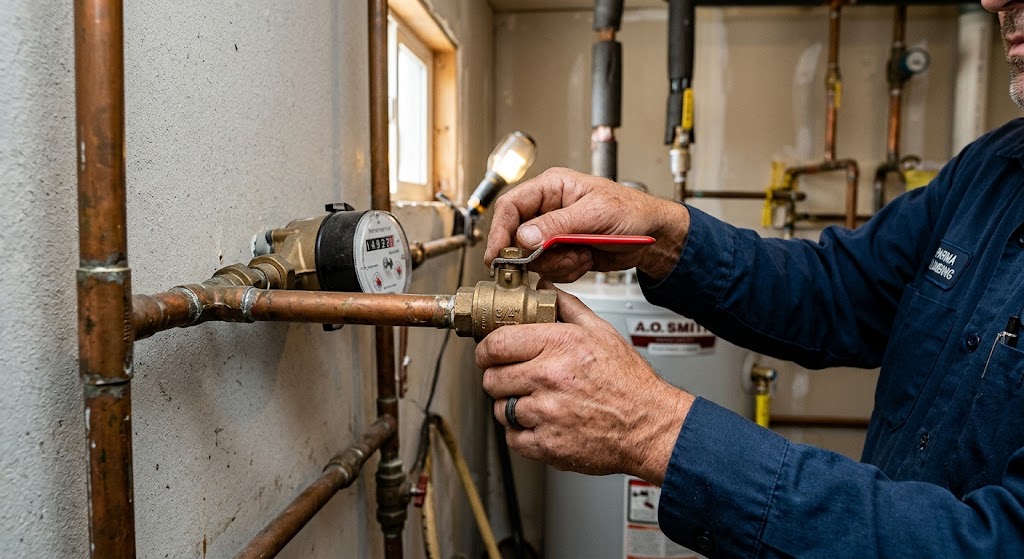
- Locate Your Main Water Shutoff Valve: Before attempting any thawing, verify that you can operate your home's main water shutoff valve immediately if a split opens as the ice melts.
Long-Term Thermal Defense and Winterizing Strategies
Preventing future pipe freezes requires eliminating thermal bridging and sealing draft paths:
- Seal foundation rim joist gaps with expanding closed-cell polyurethane foam to block sub-zero air infiltration.
- Install pre-slit closed-cell polyethylene foam pipe insulation sleeves (minimum 1/2-inch wall thickness) over all domestic hot and cold supply pipes in unconditioned spaces.
- In severely vulnerable crawl spaces or unheated utility closets, install self-regulating commercial electric heat trace cables equipped with integrated thermostat controllers.
- During extreme nights below 10 degrees Fahrenheit, allow cold water faucets on exterior walls to maintain a steady pencil-lead trickle to keep water constantly moving through the municipal service loop.